

Panic, Policy, and the Final Acceleration
Why panic, liquidation, and policy coordination may be setting up the next parabolic phase of the boom
A few months ago I wrote about what I believe is one of the most important market cycles I’ve uncovered in years. Since then, the market has continued to track that framework remarkably closely.
That doesn’t mean history is going to repeat tick for tick. Markets never move with that kind of certainty. Every cycle has its own nuances, its own catalysts, and its own path. But when the larger conditions I warned about keep falling into place month after month, you have to start paying attention.
Those of you who have followed my work for a while know I’ve been macro bullish since early 2023. Over the last two years I’ve become increasingly vocal about a Roaring 20s scenario, a period where AI, financial technology, capital spending, and policy coordination combine to produce a far larger boom than most people currently believe possible.
What changed over the last few weeks is not the thesis.
What changed is that the market has finally delivered the shock phase that historically precedes the final acceleration of a major melt up.
Just look at some of the key events that unfolded over the last month:
Korean equities experienced violent drawdowns. Memory and semiconductor-related names are 40-70% off their highs and stress emerged in the Japanese yen. Together these events have triggered sovereign liquidity concerns and forced increasingly visible responses from Asian policymakers and the U.S. Treasury.
At the same time, one of the more prominent AI funds, Situational Awareness, has imploded in a way that has drawn comparisons to Long-Term Capital Management in 1998.
When you take into account where we are in our framework for the cycle, this sequence begins to reveal far more than just the headlines.
The historical pattern for manias has been remarkably consistent:
First comes a panic.
Then comes the policy response.
Then comes the most explosive phase of the entire cycle.
Most investors assume a 40–70% collapse in the hottest speculative assets means the bubble is ending.
History tells us that genuine bubbles rarely die that way.
They shake people out first. They liquidate weaker players. They create the emotional conditions that make policymakers step in.
And only then do they produce the kind of parabolic advance that defines the final stage of a mania.
That is the framework for this report.
I want to show you why I believe the recent correction has done more to confirm the larger cycle than to invalidate it, why the policy response is already beginning to unfold, and why the market may be much earlier in this speculative boom than the current consensus appreciates.
When Leverage Breaks
The latest example is almost too perfect.
A prominent AI fund called Situational Awareness has imploded. Bespoke recently compared the setup to the Long-Term Capital Management collapse in 1998, and the timing alignment is striking.
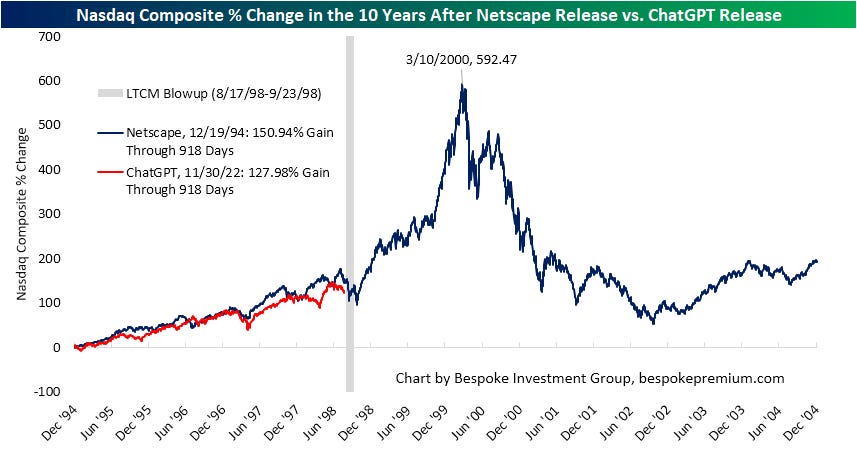
Read those names again:
Long-Term Capital Management
Situational Awareness
You couldn’t write better irony if you tried.
But the important part isn’t the humor. It’s what usually happens when highly leveraged players get blown out during the middle of a powerful secular theme.
You have to understand the ruthless nature of markets to fully appreciate this moment. One of the cruelest things they do is take capital away from weaker participants right before the biggest moves begin.
That’s why I don’t view the collapse of a speculative AI fund as evidence that the AI trade is over. In fact, I’d argue the opposite. When stronger players step in and absorb the assets of a distressed seller, it tells you the smart money is positioning for continuation, not collapse.
The Anatomy of a Real Mania
One of my favorite examples from the 2021 crypto cycle is Axie Infinity (AXS).
In November 2020, AXS had a market capitalization of roughly $7 million. Over the next six months it exploded nearly 60x, reaching a valuation above $500 million by May 2021. Then it collapsed more than 70% in the span of two months.
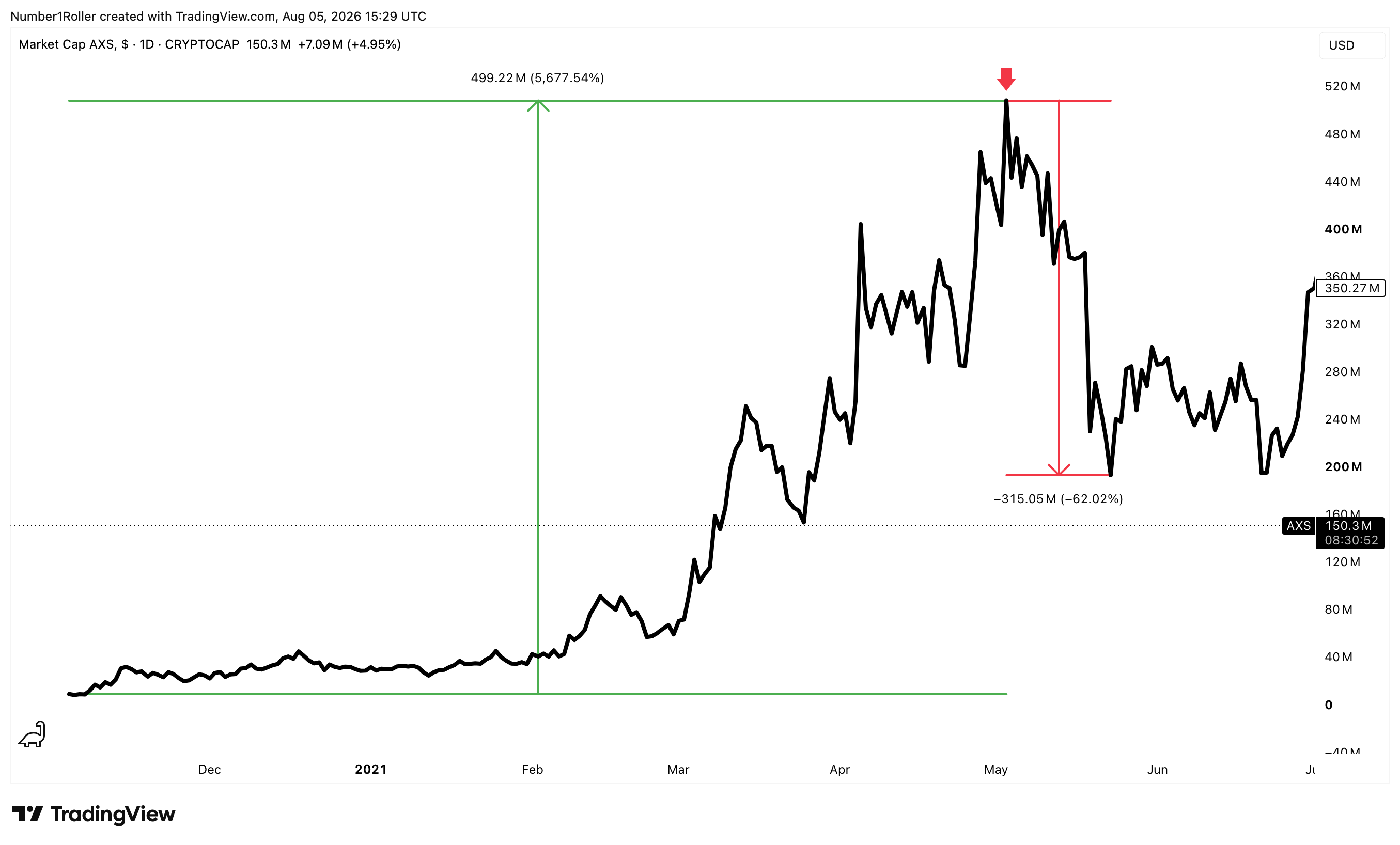
Most investors would look at that chart and conclude the story was over.
It wasn’t.
After the 70% collapse, AXS went on to rally another 17x above its initial $500 million dollar peak. The first 60x move wasn’t the mania. It was merely the setup for the mania.
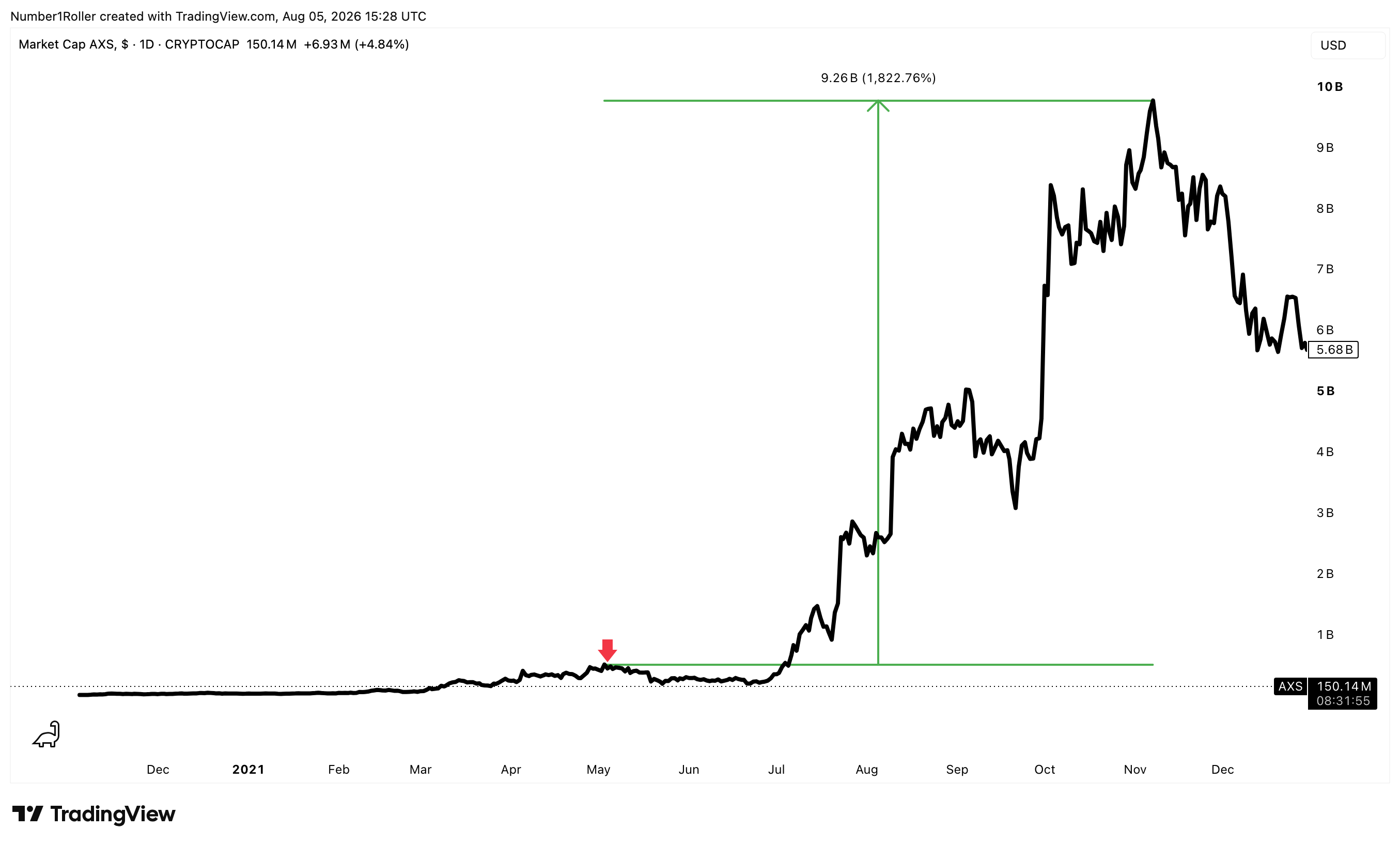
That distinction is critical.
A true bubble is not a straight line higher. It is a sequence of euphoria, collapse, disbelief, and then an even larger final expansion that leaves everyone who sold the correction or got blown out by leverage behind.
Reading the Memory Trade Through a Crypto Lens
Now apply that framework to one of the leaders of the current memory trade.
SNDK has already produced an extraordinary move, rising roughly 60x in about a year. Recently it has fallen close to 60% from its peak. In a normal market, that would look catastrophic.
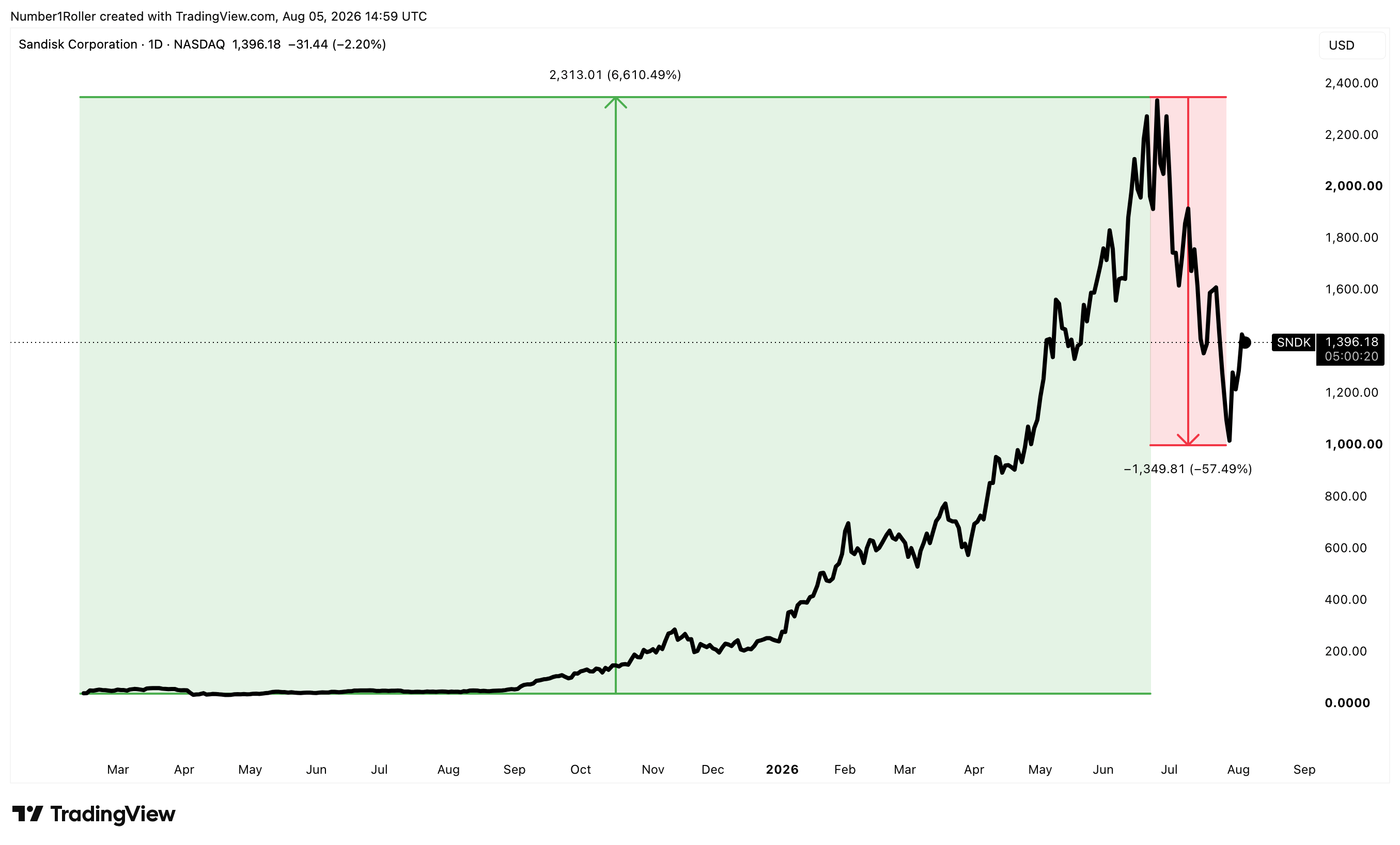
But if you overlay the 2021 AXS structure onto the SNDK chart, the resemblance becomes surprisingly interesting. The initial parabolic advance, the violent shakeout, and the potential setup for a second expansion phase all begin to line up in broad structural terms.
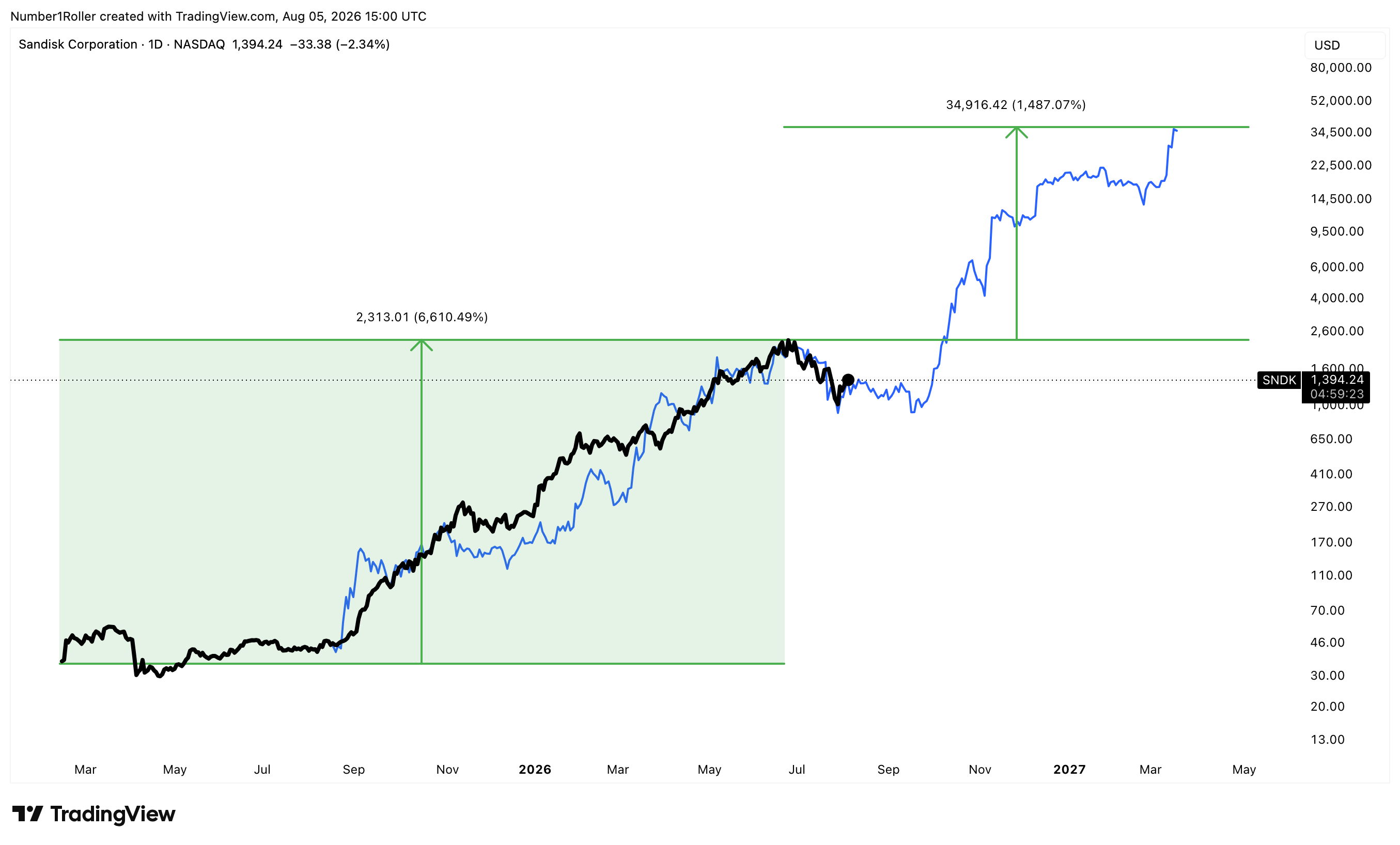
I want to be absolutely clear: I am not saying SNDK is going to replicate AXS numerically. That would be absurd.
What I am saying is that investors dramatically underestimate how far prices can travel once a genuine speculative bubble enters its terminal phase. A 50–70% correction inside a secular mania is often interpreted as the end, when historically it has frequently been only the beginning of the end.
The Missing Ingredient: Policy Assurance
The final stage of a bubble usually unfolds in a very specific sequence.
First, you get a panic.
Then you get a policy response.
Then you get the most explosive move of the entire cycle.
That is exactly what happened during the dot-com era and then most recently in 2020. We all remember the 2020 scenario but let me refresh you on the late 90s scenario.
Fed Chair Alan Greenspan warned about irrational exuberance in late 1996. The Fed tightened policy, but the bubble kept expanding through 1997 and into 1998. Then the Asian currency crisis spread across emerging markets, Russia defaulted on its debt, and Long-Term Capital Management collapsed.
By every reasonable standard, that should have ended the bubble. Instead, it triggered the policy response that sent it into overdrive. The Fed cut rates, organized a rescue of LTCM, and effectively signaled that the financial system would be supported if necessary. Read that last part again, because its going to come up in the next section.
What happened next was one of the most extraordinary moves in modern market history.
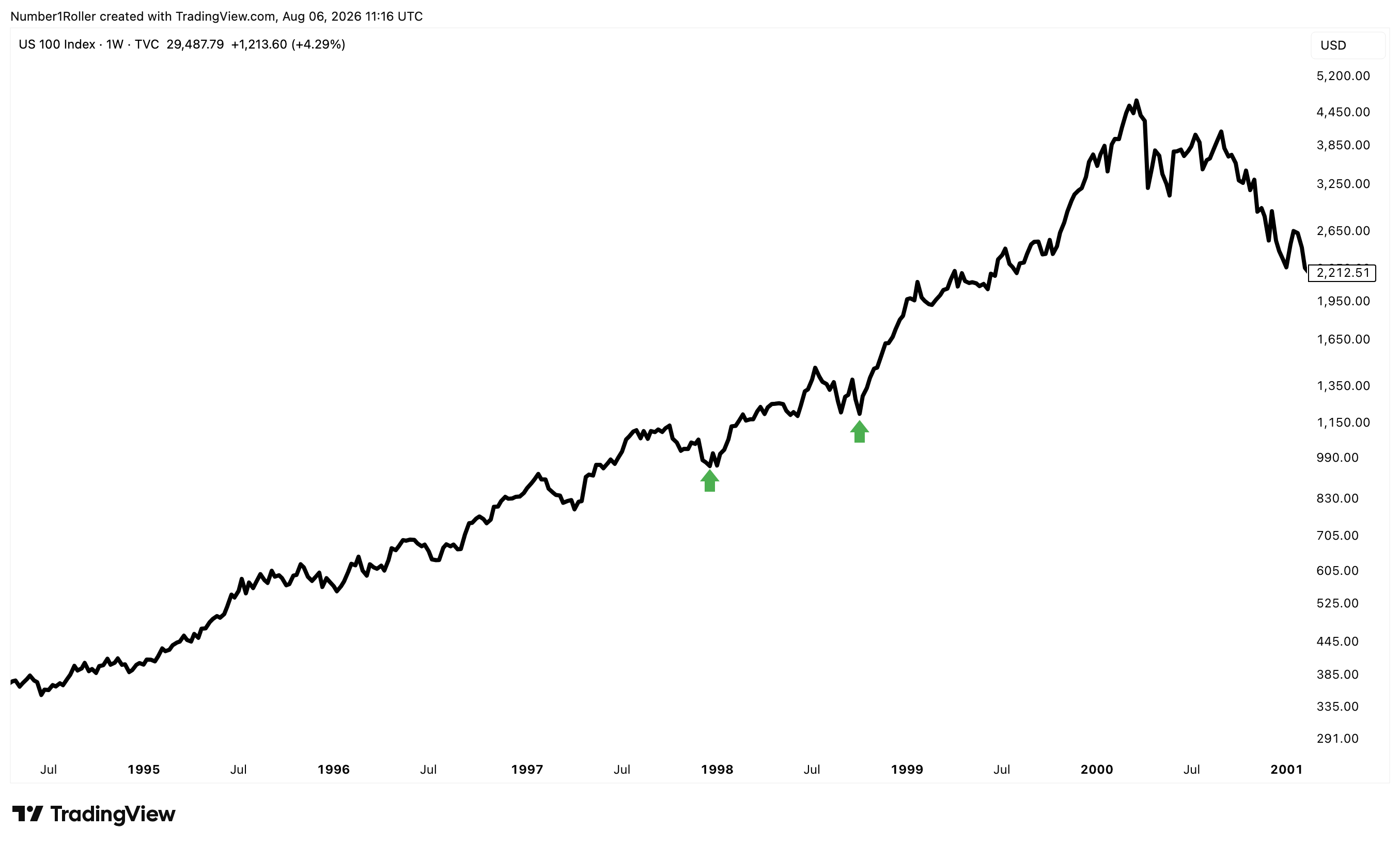
From the 1998 panic low to the March 2000 peak, the Nasdaq rallied roughly 256% in just 17 months. The panic was not the end of the bubble. It was the catalyst for the final acceleration.
That is the historical template I believe investors need to study very carefully because we just got a taste of it.
The Bigger Story Is Not AI — It’s Policy Coordination
This is where the macro picture becomes far more interesting than any individual AI stock.
Just last week the Korean KOSPI cratered, triggering an emergency response from the Bank of Korea. Within days, stress began appearing in the Japanese yen, forcing a visible response from the U.S. Treasury.
What we’re seeing is not a series of isolated market events. It’s a chain reaction moving through equities, currencies, sovereign liquidity, and policy responses almost simultaneously.
The clearest signal came from Treasury Secretary Scott Bessent, who stated that “economic security is national security.”
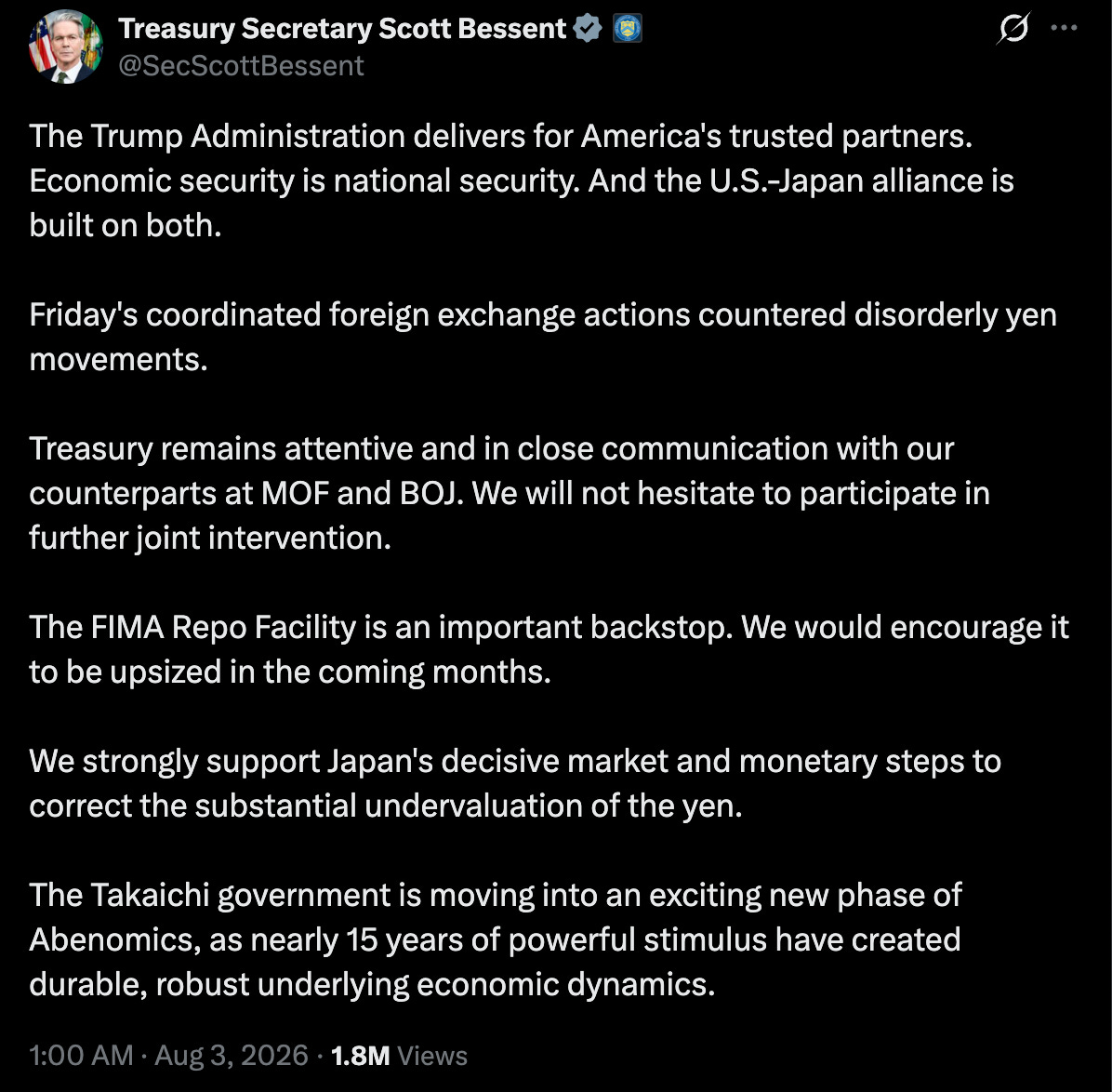
That is an extraordinarily important statement for markets.
The administration is effectively telling investors that maintaining economic stability is no longer just a domestic objective. It is a strategic priority of the United States and its allied financial system.
The dollar system is increasingly being treated as strategic infrastructure, and America’s allies appear to be operating within that same framework.
Money, Treasuries, FX markets, repo facilities, industrial policy, defense spending, semiconductors, and energy security are no longer separate conversations. They are becoming pieces of a single coordinated geopolitical and financial system.
That matters because historically, late-stage bubbles begin to emerge when technology, liquidity, and policy begin reinforcing one another simultaneously. The AI boom provides the technological catalyst. The liquidity facilities provide the financial backstop. And the growing coordination between governments provides the policy framework that reduces the probability of a disorderly systemic break before the speculative cycle has fully run its course.
From Panic to Acceleration
When I combine these recent events with the cycle work, the roadmap looks much clearer today than it did a few months ago.
The correction we were looking for has unfolded.
We’ve now seen a meaningful shakeout across AI-linked equities, a violent unwind in Korean markets, stress emerging in the yen, and a remarkably visible policy response from both Asian authorities and the U.S. Treasury. In other words, the sequence is beginning to resemble the exact playbook we we’re watching for in early July.
That is what makes the current setup so interesting.
My view is that this is far more likely to be the mid-cycle reset than the final top.
Real bubbles do not usually end when investors are still debating whether they exist. They end when the corrections stop scaring people, when leverage comes rushing back, when participation becomes universal, and when price appreciation starts looking absurd to even the most bullish investors.
We are nowhere near that environment today.
What I see instead is a market that has just absorbed a meaningful shock, received the first signs of a coordinated policy response, and may now be entering the phase where liquidity, technology, and speculative behavior begin reinforcing one another again.
That is the environment that produces the final acceleration of a melt up.
And if the historical analog continues to hold, the most aggressive part of this cycle is likely still ahead of us, not behind us.
Why the Roaring 20s Thesis Is Strengthening
This is why my bullishness has only increased over time.
The Roaring 20s thesis is not based on meme coins, AI, or short-term momentum. It is based on the convergence of several powerful forces:
Massive AI-driven capital expenditure.
Financial infrastructure modernization.
Stablecoin and digital-asset integration.
Industrial and energy reconfiguration.
Coordinated liquidity management.
A cyclical backdrop that resembles the late stages of previous transformative booms.
When these forces align like they are, the result is rarely anticlimactic.
That does not mean the path is smooth. The best secular advances in history were filled with violent corrections that convinced investors the market was broken right before it accelerated.
Right now, I believe we are at the panic and policy response phase. The panic may not be market wide but leading sectors and indexes around the world certainly got hammered at a historic clip over the last two months. The policy responses are already in motion. And if history rhymes even loosely, the most explosive part of the move is only beginning.
This is the opportunity we have been preparing for.
And it will likely look far more extreme than anything we have seen in history. The investors who understand the anatomy of a real bubble will be far less likely to mistake this major correction for the end of the story.
Time is the edge.
Fantastic article Stefan....I'm with you and agree with your statements made. Just watching the speculative advances in the meme coin sector over the last couple of weeks has been great to see. Awesome work dude.