

The Missing Piece Falls Into Place
The institutional on-chain moment we’ve all been waiting for has finally arrived.
For months I’ve been telling you crypto wasn’t waiting on what everyone else said it was waiting on.
It wasn’t waiting on another ETF. It wasn’t waiting on another institution to bless the space. It wasn’t even waiting on regulation.
It was waiting on better distribution.
And that distinction is everything. Markets don’t move when technology gets better. They move when technology gets reachable. Every adoption cycle in history runs the same sequence: infrastructure gets built, regulation slowly catches up, and only then — last, always last — does distribution show up. Distribution, in this case, is the moment innovation stops being a toy for insiders and becomes part of the actual financial system.
For a decade, crypto has been building world-class infrastructure bolted onto broken distribution.
This past week that broke open with the advent of Robinhood Chain.
Robinhood didn’t launch “another blockchain.” Robinhood introduced the one thing this industry has never had: a distribution network that can pull tens of millions of already-funded brokerage customers on-chain, through an app they already open, already trust, and already keep money in.
That is not another exchange listing. It’s not another L2 press release. It’s not another institutional pilot that goes nowhere.
It’s THE missing piece.
And it showed up almost exactly where the cycle said it should.
Framework First
Most investors let the headlines build the framework.
We do it the other way around.
Build the framework first. Then judge whether the news strengthens it or breaks it. If you don’t know what you’re looking for before it happens, you’ll get faked out by every headline that scrolls past. That’s our whole discipline in one line — the territory comes before the map, always.
So here’s what we’ve been tracking all year — long before this launch:
Risk appetite expanding. Capital rotating out of tech and into financials. Breadth improving underneath the surface. Institutional participation accelerating. A regulatory backdrop that keeps getting more constructive.
Any one of those is a data point. Stack them together and they stop being data points — they describe a market moving into the final expansion phase of a much larger cycle.
But there was always one ingredient missing.
Not another chain. Not another token. Not another promise from a founder in a hoodie.
Distribution.
The question nobody in this space has answered for ten-plus years: how do you actually move millions of ordinary investors from traditional finance onto on-chain rails?
This week, Robinhood gave the first credible answer anyone’s produced.
The Distribution Problem
Crypto has never had an innovation problem.
It has a customer-acquisition problem.
Every protocol, every app, every chain has been forced to solve the same brutal equation: go get users one wallet at a time. Spend a fortune on incentives, airdrops, and mercenary liquidity — then watch that liquidity scatter across hundreds of competing ecosystems the second the rewards dry up.
The tech keeps getting better. The distribution never catches up. That’s the treadmill this entire industry has been stuck on.
Robinhood walks in and flips the equation.
Instead of begging millions of people to discover crypto — download a wallet, bridge assets, learn a foreign financial system, and try not to get drained in the process — Robinhood starts from a completely different place.
A funded customer.
That single starting point changes everything.
The Distribution Math
This is the part almost everyone is fumbling.
Robinhood serves close to 28 million funded customers across 38 countries and three continents. Within its first week, the chain processed roughly 4 million transactions and pulled in over $240 million in deposits.
Impressive numbers. But the numbers aren’t the story.
The ratio is the story.
Even on generous assumptions, only a sliver of Robinhood’s base has touched this chain. Low single-digit adoption, at most. And that sliver was enough to drop this network straight into the conversation as one of the most active new ecosystems in crypto out of the gate.
That’s the whole idea in one line: this is 1% of the base showing up, and it already broke records.
Everyone’s staring at the current activity. I’m staring at the denominator.
And here’s what “barely switched on” already looks like against the most-hyped enterprise chain in the space:
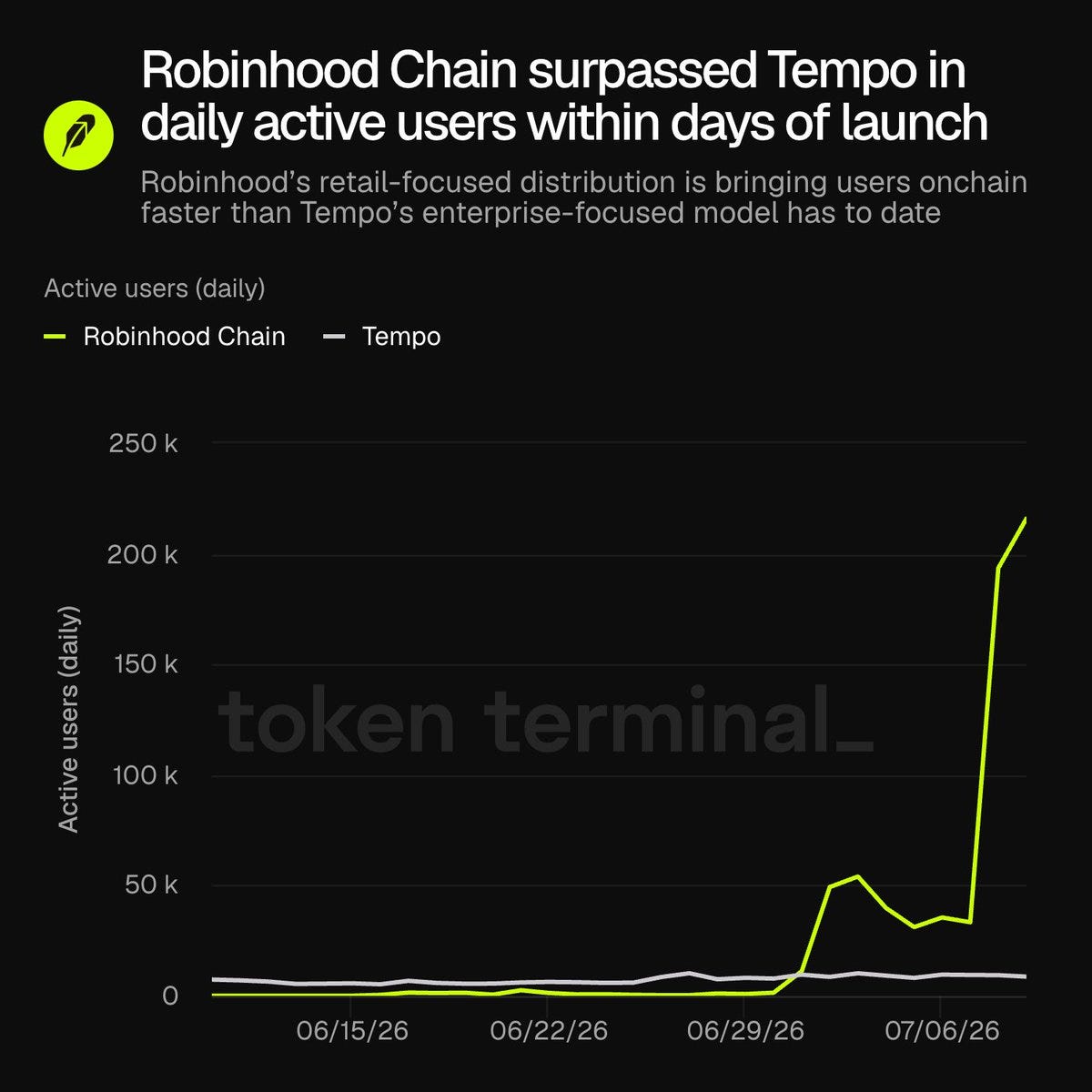
This is the distribution thesis in one chart. Tempo — Stripe’s enterprise-focused chain — has been flatlining along the bottom for weeks. Robinhood came online and blew past it in days. Enterprise chains chase deals. Retail distribution just opens the app to a base that’s already there. That’s the entire difference, and it’s the difference that wins.
Twenty-eight million funded accounts. Already onboarded. Already investing. Already trusting the platform with real money. The chain isn’t anywhere near saturation — it has barely been switched on.
And this is the part that matters most: those aren’t recycled users. They’re new ones.
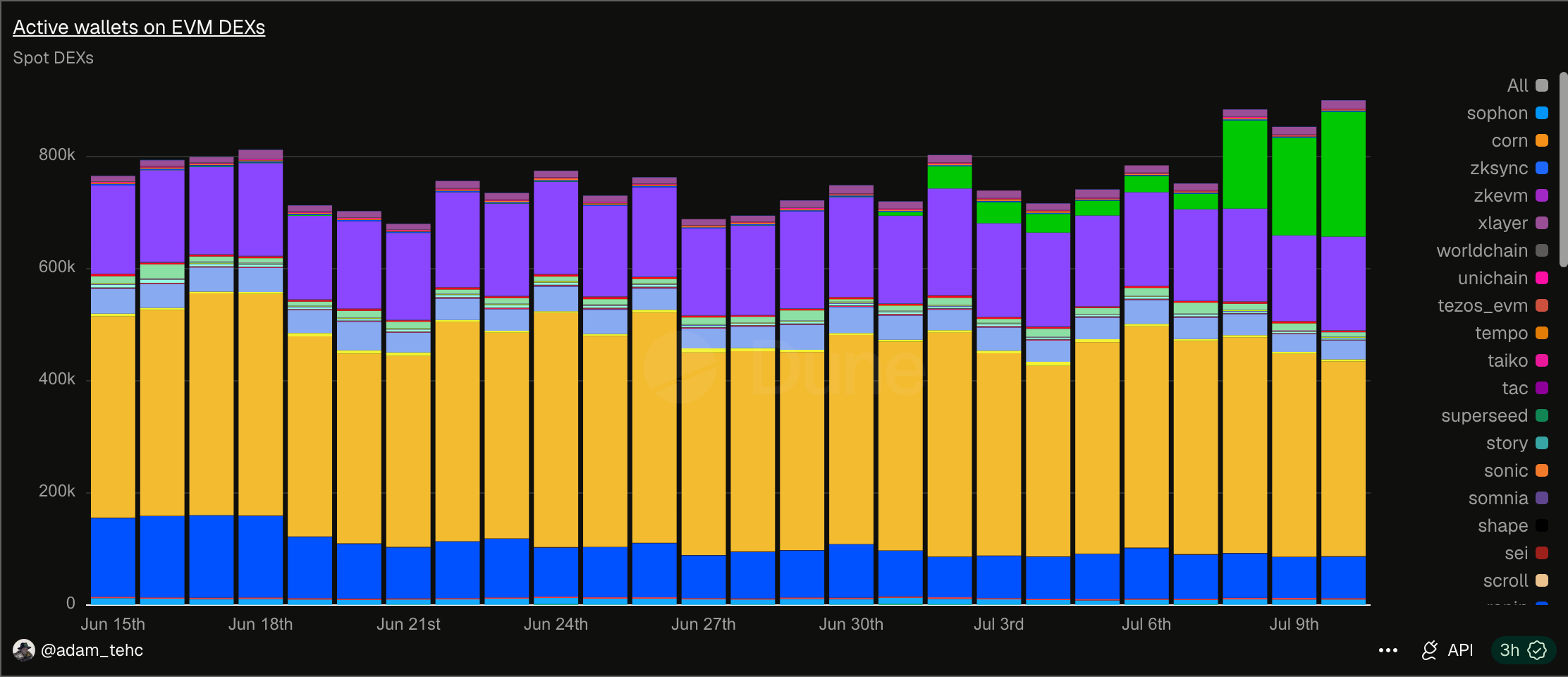
Watch the green. Robinhood didn’t slice its share out of the existing pie — it grew the whole pie. Active wallets across every EVM DEX pushed to new highs in early July, and the new volume is almost entirely Robinhood. That’s the difference between rotation and distribution. Rotation moves the same tired users around the same chains. Distribution brings people who weren’t here yesterday. This chart is the second kind.
Put it in perspective. At the peak of the last on-chain cycle, Solana’s ecosystem was running well over 100 million monthly active users. Robinhood is sitting on a warm, KYC’d, funded audience approaching a third of that number before it asks a single person to download a wallet.
It doesn’t have to acquire the relationship. It already owns it.
That is a completely different starting line than any blockchain that came before it. And the capital is already bridging in to match:
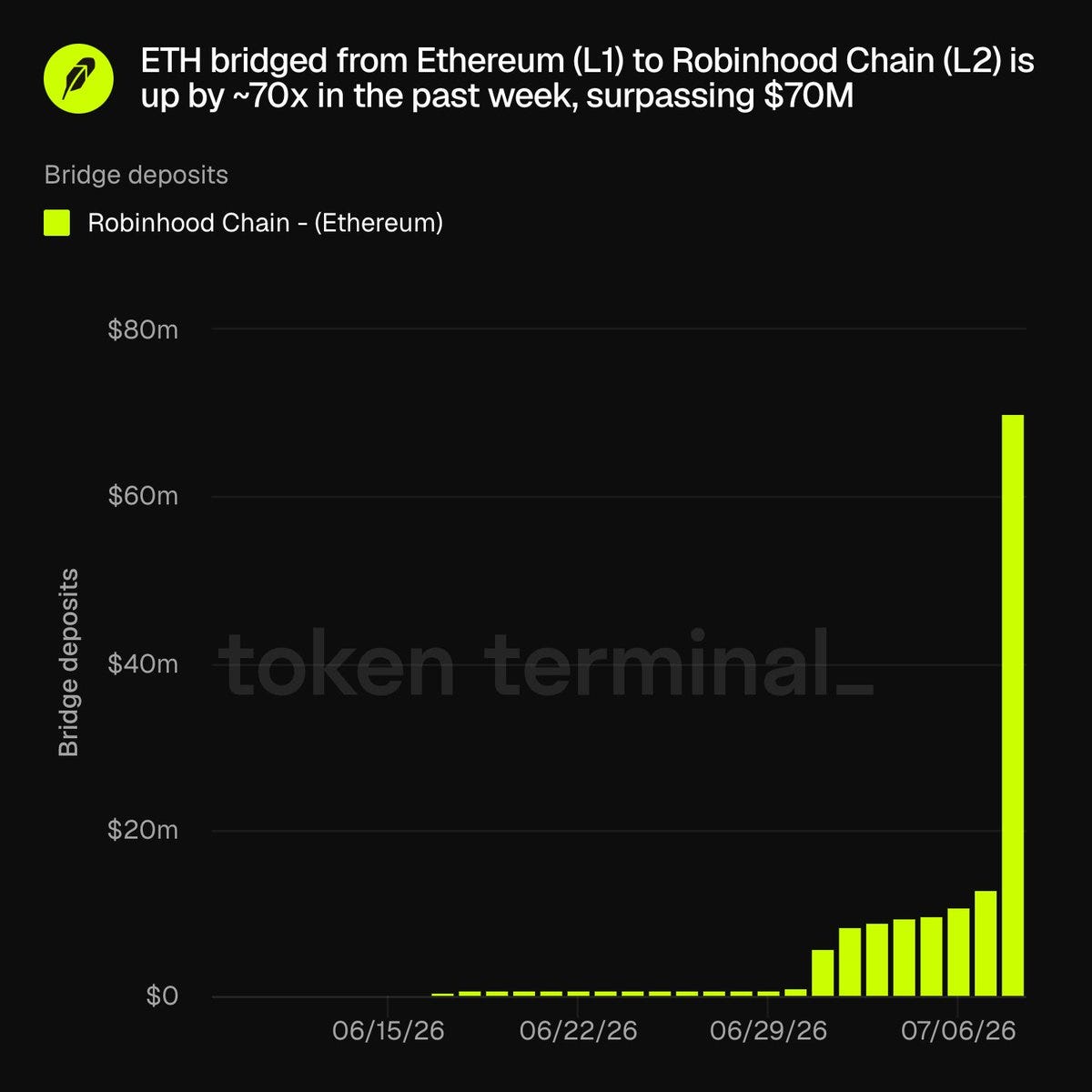
ETH bridged onto the chain is up roughly 70x in a single week, blowing past $70M. That’s not a marketing number — that’s real capital physically moving onto the rails. And because the chain runs on ETH for gas, every one of these users becomes a new, permanent source of ETH demand. The on-ramp isn’t theoretical. It’s live, and it’s filling up faster than anyone thought.
Why Now?
Timing is not a footnote here. It’s the whole argument. It’s the whole reason Temporos exists.
Run this exact same launch in the depths of the 2022 bear market and it’s a curiosity. A neat experiment nobody trades. Same product, same tech, same partners — and it means almost nothing.
Drop it here, at this point in the cycle, and it means something entirely different.
Markets don’t go euphoric off one catalyst. They go euphoric when independent forces start reinforcing each other.
Infrastructure. Regulation. Capital flows. Breadth. Distribution.
One force alone rarely defines a cycle. Five arriving together is how euphoria gets built over the next eighteen months. That’s why this launch earns your attention. Not because Robinhood shipped a chain. Because it may be the first large-scale solution to the oldest structural problem in crypto.
And if that’s true, this isn’t a headline.
It’s confirmation the next phase is already underway.
Infrastructure Meets Distribution
The headlines went straight for the tokenized stocks.
I get it. NVIDIA and Apple trading 24/7 on-chain is a clean, tangible story — easy to picture, easy to explain, easy to headline.
It’s also not the part that matters most.
The real story is everything Robinhood built around those assets. For the first time, a mainstream brokerage isn’t just handing customers crypto exposure — it’s laying the rails to move traditional financial activity directly on-chain.
Slow down on that, because it’s easy to breeze past. Listing digital assets is one thing. Building the plumbing where traditional finance and DeFi actually converge is something else entirely.
And here’s what separates this from every corporate-chain press release you’ve learned to ignore: Robinhood didn’t launch an empty promise with a roadmap. It launched loaded.
Ninety-five tokenized equities. A native Layer-2 on Arbitrum. Institutional custody through BitGo. Chainlink as the oracle layer. Uniswap deploying dedicated liquidity. A full DeFi stack live. Markets running around the clock.
From day one. Not “coming in Q3.” Live.
And it’s not just live — it’s fast. This isn’t a slow, clunky corporate chain duct-taped together for a press release:
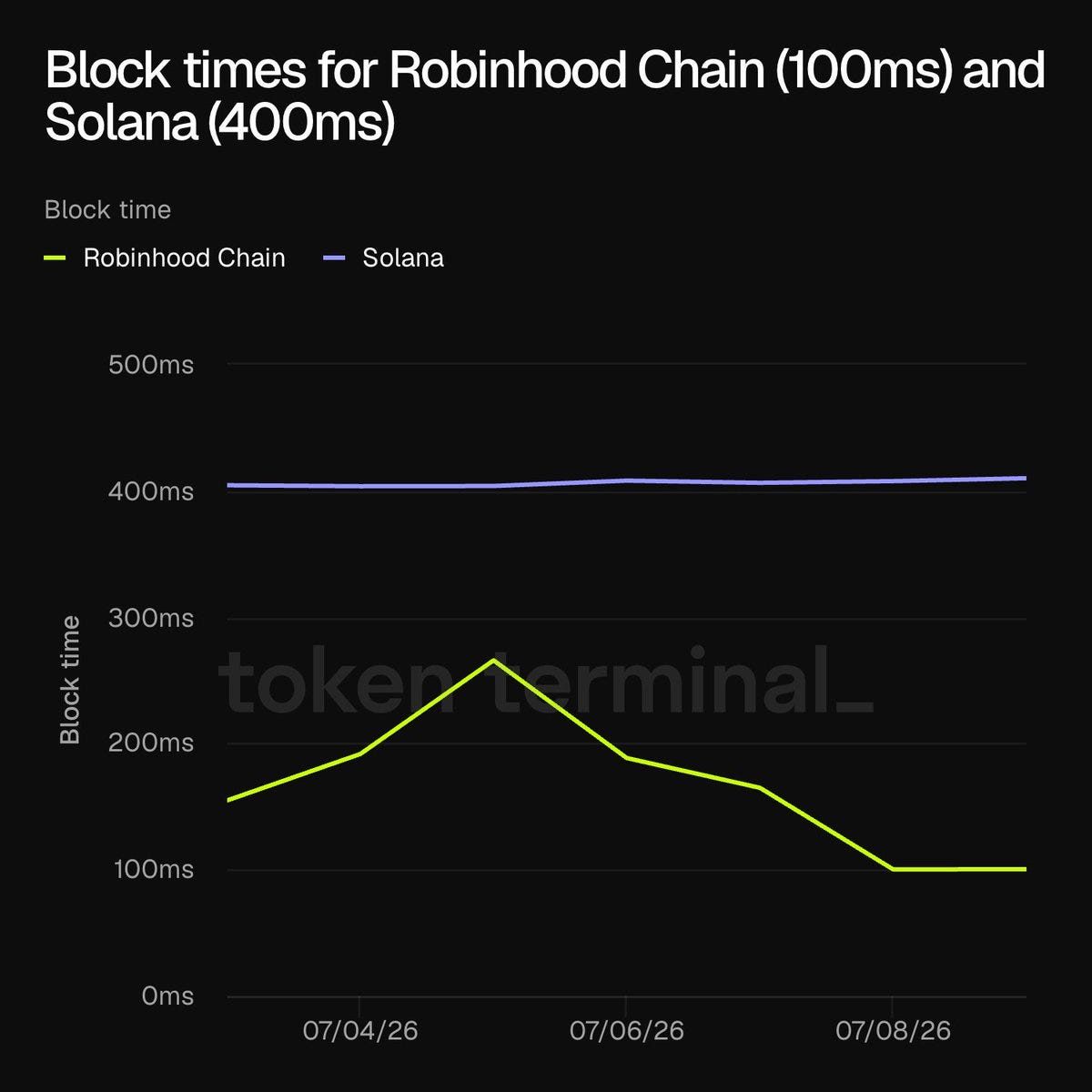
Robinhood Chain is settling blocks at ~100ms — four times faster than Solana, the chain the entire industry holds up as the speed benchmark. This is what “built to institutional standards” actually means in practice. The plumbing isn’t a compromise. It’s best-in-class out of the gate.
That matters because adoption doesn’t follow announcements. It follows products people can actually use — and this thing shipped usable and fast.
The Telltale Statistic
After launch, one statistic jumped off the screen. Not transaction count. Not deposits.
Turnover.
Roughly $570 million in day-one volume against about $21.68 million in total value locked. A turnover ratio near 26:1.
Sit with that, because it doesn’t exist anywhere else at comparable scale. Most mature DEXs — protocols with years of battle-tested liquidity — run at or below 1:1. Robinhood turned over its entire liquidity base twenty-six times in a single day.
Normally, liquidity accumulates first and trading follows. Robinhood got the opposite. Demand showed up faster than liquidity could form to hold it.
Markets don’t print numbers like that under normal conditions. They print them when a distribution network dumps more users into a system than the existing infrastructure can absorb.
That’s exactly what this looks like. And the raw activity backs it up. Look at what happened to transaction count in a week and a half:
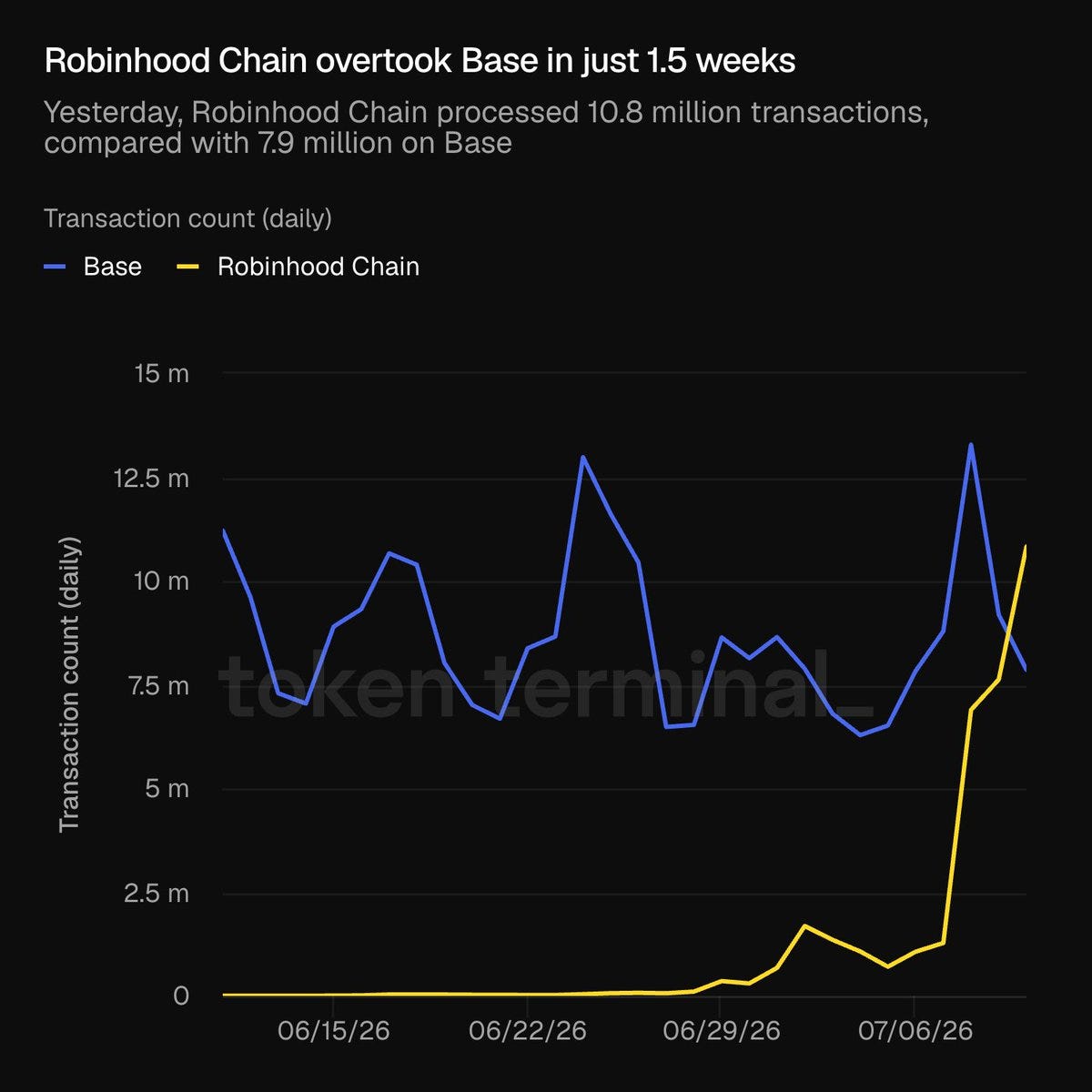
This is the one that should stop you cold. Base has had years to build up to ~9 million daily transactions. Robinhood Chain beat it — 7.6 million in a single day — a week and a half after launch. A multi-year gap, closed in eleven days. That’s not organic growth. That’s a distribution firehose.
The point isn’t that 26:1 lasts forever. It won’t — liquidity fills in and the ratio normalizes. The point is what those first days revealed: there is far more demand for accessible on-chain finance than the infrastructure was built to handle.
That’s not speculative froth. That’s evidence that distribution — not technology — has been the bottleneck all along.
⸻ THE REST OF THIS REPORT IS FOR PAID SUBSCRIBERS ⸻
Below: the piece the headlines missed — the insured-yield trojan horse that pulls conservative capital on-chain, the corporate-chain landgrab Robinhood just joined, the two honest risks that could break this thesis and why the data is already answering them, and exactly how this launch slots into the cycle I’ve been mapping all year — including the one line that would prove me wrong. This is the edge. Paid members read on.